Choose The Right Removal Route
A redundant fuel tank can occupy a loading bay, block a refurbishment or sit behind equipment installed long after it arrived. Commercial fuel tank removal in Birmingham starts by working backwards from the space you need cleared. The size of the tank matters, but the route between that tank and the collection vehicle often decides the method.
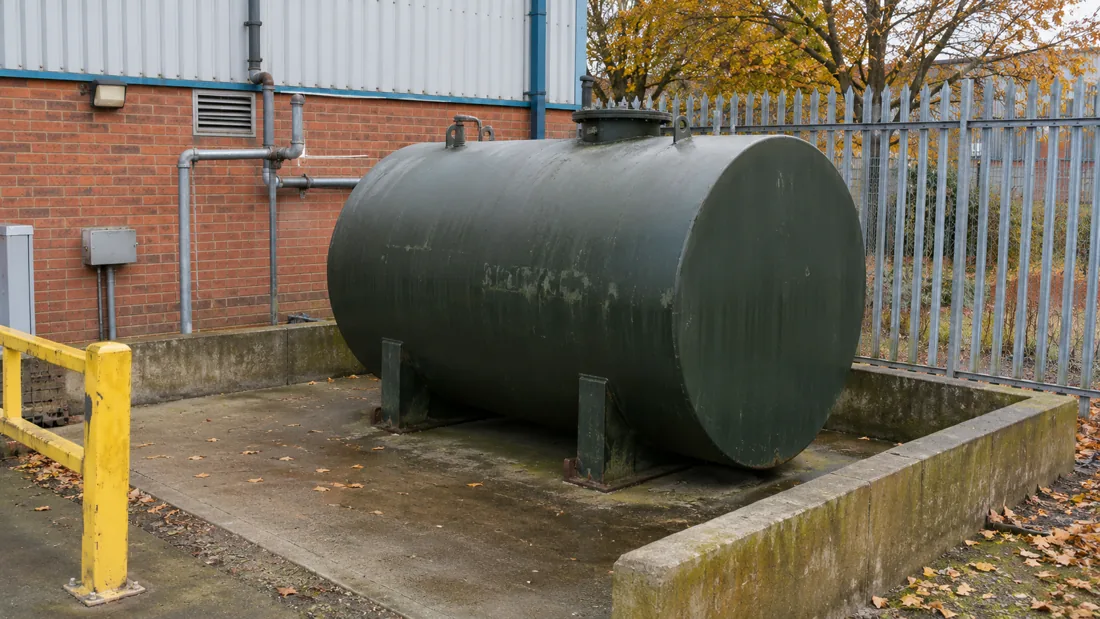
An accessible above-ground tank may be suitable for removal whole after preparation. A tank inside a plant room may need controlled dismantling into manageable sections. A buried tank adds questions about excavation, underground services, ground condition and the intended finish above it. Tell us which situation applies before arranging other trades around the work.
Lift Whole Or Dismantle In Place?
Use the access route as your first decision guide. If a cleaned tank can pass through the available opening and a lifting vehicle can safely reach its position, a whole-tank lift may be considered. Where doorways, roof structures or fixed machinery obstruct that route, sectioning may be the practical option.
Cold cutting is a method to assess for restricted indoor locations, rather than an assurance that a tank can be cut without preparation. Residue and vapour still need attention. Do not start cutting, remove a hatch or try to drain the tank yourself to make the quotation easier.
If the tank is underground and excavation would conflict with a building or operational route, compare removal with a separately assessed decommissioning solution. Leaving a tank in place needs a recorded plan. It should never happen simply because the removal team discovers an obstruction on the day.
Account For Fuel Before Metal
Capacity and remaining contents are different figures. A tank labelled with a large capacity may hold little usable fuel, while an apparently empty tank can retain sludge and liquid below the draw-off point. Send the most recent gauge reading, delivery information and any known contamination history, marking estimates as estimates.
The scope should distinguish fuel suitable for recovery from water, sediment and material requiring disposal. If retained fuel is to supply a replacement system, the receiving storage and its suitability need agreement. Do not assume that scrap value will cover fuel handling, transport or cleaning costs.
Where the tank feeds heating, dispensing equipment or standby power, the shutdown must be agreed with the person responsible for that system. A replacement tank or temporary supply is a separate planning requirement. Removing a vessel does not automatically include recommissioning everything previously connected to it.
Survey The Entire Way Out
Photograph the tank from a safe position, its support or bund, visible connections and each change of direction on the exit route. Include doors, gates, steps, ramps and any low overhead structures. An overall yard photograph is more useful than a close-up of the nameplate on its own.
For a lift, identify possible vehicle standing areas and what lies beneath them. Covers, buried services, soft verges and restricted loading areas can change the lifting arrangement. Nearby deliveries, pedestrian routes and neighbouring occupiers also need space while work is under way.
In Birmingham service yards, a gate may be wide enough while the turn immediately beyond it is not. Send approximate clear widths and heights if known, but do not move heavy equipment or enter an unsafe space to measure. A survey resolves uncertainty before a removal method is committed.
Agree Preparation And Site Controls
The programme should describe assessment, isolation by appropriate competent people, fuel uplift, residue removal and cleaning before lifting or cutting. Testing and any further atmosphere controls depend on the tank history and proposed method. A tank described as empty is not evidence that it is safe for hot work.
HSE’s DSEAR guidance explains workplace duties around fire and explosion risks. The site-specific method needs to address the actual substances and tasks. Where entry is unavoidable, the confined-space assessment and rescue arrangements must be settled before work begins.
Ask who coordinates permits, exclusion zones and other contractors. If access crosses a shared yard, permission to occupy that space should be confirmed in advance. Preparation that depends on a landlord or adjacent tenant can govern the programme as much as the tank itself.
What Changes Cost And Handover
The quotation should identify fuel handling, cleaning, dismantling or lifting, transport and disposal. Restricted working hours, difficult hose routes, excavation, specialist lifting and reinstatement can add distinct costs. Ask whether removal of the bund, plinth, connected pipework or redundant fill point is included.
Agree the end state in writing. A cleared tank footprint is different from a demolished base, reinstated slab or excavation prepared for another contractor. Suspected contaminated ground needs separate assessment rather than being hidden within a general promise to leave the area tidy.
Request the applicable waste transfer or hazardous waste consignment documentation, a record identifying the removed tank and any agreed disposal confirmation. GOV.UK explains the business waste responsibilities that remain relevant when you use a contractor. Lifting documentation and hot-work-related certification depend on the method used. Keep the handover with your premises records, then update drawings so the next contractor knows what has actually gone.
Fuel Tank Removal: Questions
Can A Tank Come Out Through A Small Door?
A tank behind a small door may be removable in sections after its contents and condition have been assessed. Send photographs of the full route, including corners and stairs. The method depends on safe working space as well as the opening size, so a small doorway does not by itself confirm that dismantling is possible.
Does Removal Include The Concrete Base?
Tank removal includes the concrete base only when demolition and disposal of the base are in the agreed scope. Some projects need the plinth retained for replacement equipment. Tell us whether you want an empty footprint, a level slab or a surface ready for another contractor, so the quotation addresses the correct finish.